¶ Introduction: Why Laser Focus Defines Engraving Precision
When you zoom into a laser-engraved line, what you're really seeing is the effect of laser focus — the point where energy density reaches its peak. Whether engraving fine patterns on leather or cutting thick acrylic, laser focus dictates how efficiently light energy converts into heat.
A perfectly tuned focus yields sharp edges, clean cuts, and consistent depth. A poorly set focus leads to blurry marks, excessive charring, and wasted material.
¶ Understanding Laser Focus: From Collimation to the Focal Point
Raw laser light exits the resonator as a collimated beam—long, parallel, and not yet suitable for processing. A focusing lens compresses this beam into a tiny, high-energy point called the focal point.
The focal spot size defines how much the beam narrows. Smaller spot = higher energy density (W/mm²), which is crucial for precise engraving.
Larger spot = broader energy distribution, often better for thick material cutting.
¶ The Mathematics of Focal Spot Size
The focal spot size ((d_f)) can be approximated by:
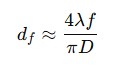
Where:
λ = wavelength
CO₂: 10.6 μm
Fiber: 1.06 μm
f = lens focal length
D = beam diameter before focusing
What this means in practice:
Shorter wavelength → smaller spot
Shorter focal length → smaller spot
¶ Example
CO₂ laser + 2" lens → ~0.1 mm spot
Fiber laser + 2" lens → ~0.01 mm spot (10× smaller)
This is why fiber lasers can produce extremely fine markings.
¶ Depth of Focal Point: The Hidden Variable
The depth of focal point (depth of field) describes how far above or below the focal point the beam remains effectively focused.
Narrow depth = high precision, low tolerance
Deep depth = lower precision, high tolerance
¶ Lens Comparison Table
Lens Type |
Spot Size |
Depth of Field |
Best For |
1.5" Lens |
Very small |
Narrow |
Fine engraving (metal, plastic) |
2.0" Lens |
Balanced |
Moderate |
General cutting + engraving |
4.0" Lens |
Large |
Deep |
Thick cutting, uneven surfaces |
Short-focus lenses emphasize resolution.
Long-focus lenses emphasize penetration and consistency.
¶ How Spot Size and Depth Work Together
Focal spot and depth define the laser-material interaction zone:
Smaller spot = sharper detail, but requires precise Z-height
Larger spot = deeper penetration, better for thick cutting
For cutting thick materials, operators often place the focal point slightly below the material surface to optimize kerf shape.
For engraving, the focus must sit directly on the surface to maintain crisp line width.
¶ Focus Strategies: Engraving vs Cutting
¶ For Engraving
Goal: Maximum clarity, minimal heat spread
Focus: Exactly on material surface
Lens: 1.5"–2.0" short-focus
Materials: anodized aluminum, acrylic, coated metals, wood
Incorrect focus leads to wide, faint, or burnt lines.
¶ For Cutting
Goal: Strong energy penetration through thickness
Focus: 0.5–1 mm below top surface
Lens: 2.5"–5.0"
Materials: MDF, stainless steel, acrylic, leather
Correct focus avoids tapering, uncut edges, and burnt kerfs.
¶ Practical Example: 2" Lens vs 4" Lens
Parameter |
2" Lens |
4" Lens |
Spot size |
~0.1 mm |
~0.2 mm |
Depth of focus |
~2 mm |
~5 mm |
Thin-sheet cutting |
Excellent |
Moderate |
Thick-sheet cutting |
Limited |
Ideal |
Engraving resolution |
High |
Lower |
This is why many professional users keep multiple interchangeable lenses.
¶ Common Focus Adjustment Methods
¶ 1. Manual Focus
Using a gauge, block, or focusing tool to set a fixed distance.
¶ 2. Auto-Focus Systems
Use height sensors or cameras to detect optimal Z-distance automatically.
¶ 3. Dynamic Focus
Used in advanced galvo systems; the focus shifts continuously during scanning.
¶ Maintenance: Keeping Optics in Peak Condition
Even the best focus won’t work with dirty or misaligned optics.
¶ Maintenance Checklist
Clean focusing lens weekly with optical wipes + IPA
Check mirror alignment after transport
Verify Z-axis calibration before long jobs
Replace scratched or fogged lenses immediately
👉 Learn more in our optics care guide: OneLaser Laser Maintenance Tips
¶ Conclusion: Precision Begins at the Focus
Laser performance is defined by how accurately energy converges at the focal point.
Focal spot size controls engraving detail
Depth of focal point controls tolerance and cut consistency
When both are optimized, you get faster jobs, sharper edges, less burn, and longer machine life.
Whether engraving jewelry or cutting carbon fiber, remember:
A laser is only as sharp as its focus.